Saturday, June 22, 2013

Maintenance on the Fig Leaf Cottage

After 4 years, it seemed like an appropriate time to make some repairs to the first cottage that I designed and built. The weather had taken it's toll on the earthen exterior plaster, and the green roof had begun to rot the untreated/unpainted fascia boards (the horizontal boards that span the rafter ends and hold the green roof in place). I have learned a lot about building since I embarked upon this first journey, and so I do things differently these days (details, mainly), but I am still surprised at how well everything has held up!

This is what it looked like last weekend:


Below is at the corner of the front windowsill. The white lime plaster has held up well, but the clay plaster got totally eaten away at the seam between the two plasters. The sill should have been built out with cob to create an overhand and drip point. Or the lime should have at least extended further down then we had it.


The plaster got weathered in an interesting manner. The pattern of divots is beautiful in a way, but would lead to the degradation of the cob over time, if not repaired.


I scratched the plaster up, to allow for the new coat of lime to bond to it.


The lime immediately starting to dry and lighten in color, as you can see below. The earthen plaster was dry as a bone and very thirsty.


After re-plastering the exterior, we began to paint all of the rafter ends and the underside of the roof deck. The lumber wasn't in horrible shape, but it had started to show signs of future rot and was stained by water.


I removed all of the old fascia boards, numbered them, and used them to cut duplicates out of fresh, pressure-treated, painted lumber. Then I screwed the new pieces all back up, and they fit wonderfully!


We decided to paint the fascia and window trim blue, but it won't quite be the blue you see below. I found this blue to be too bright after seeing it on the building. So I took it back to the store to get it dulled down, and will go back to do a slightly grayer finish coat tomorrow.


Check out that living roof! It's doing wonderfully, even without much soil left up there. There are bees buzzing between the flowers on the roof, and the variety of ecology is great.


We are going to lime-wash the interior of the building, and then paint it with a homemade, natural lime/milk paint. Here are some lime-wash test patches that we did at the end of the day. The reason for painting the interior is because the plaster is a bit too dusty. We have learned a lot about mixing good plasters since this cottage was built, and no longer have these same dustiness problems.


In some ways it feels sad to be changing the look of the cottage so much, because it was so charming and blended in so well in its landscape. But it also feels really good to be putting some love back into a building that I have missed spending time with. And knowing that it will now be able to go another 10 years before needing another maintenance job is fulfilling.


Mortar Mixer Cob with Greg

I recently took a day to go out an help a former cob workshop participant (also named Greg) mix some cob for a project that he took on in his backyard. We wanted to mix a lot of cob in a short period of time, so we rented a mortar mixer to help.


Greg is building a playhouse and/or garden shed. The foundation is all urbanite, that he mortared together.


The quality of cob that we got from the mortar mixer was really quite good. We mixed it on the wet side, so that we could wrap it in the tarp and keep it usable for a couple weeks (and Greg could use a little bit each day, as he had time).


One advantage of the mortar mixer is that it dumps the cob right out into the wheelbarrow for you, when you tip the drum.


A disadvantage of course it that is burns fossil fuels, and is really, really loud. This was my third experience using one, and I enjoyed the opportunity. When building alone, it can become exhausting and demoralizing to have to mix cob with you feet every day (to be fair, using the mixer is also exhausting to the upper body, because you have to lift all of the buckets of materials up into the mixer drum). Sometimes the building is the really fun and inspiring part, and having to stop to mix every hour ruins the flow you might be able to achieve. So having a tarp full of weeks worth of cob from one day using a machine can be pretty neat.

Carlton Update

I haven't done a post in so long, that it feels impossible to catch up in any sensible, easy-to-understand way. I hope the photos say more than I can.


Lots of trim!


I just recently began experimenting with homemade milk/lime paint. It's really exciting to be able to make a paint out of just 4 ingredients! The clay pigment is from the Blue Ridge Mountains (in Western NC - pretty local). The pain also has lime. And "quark" - which is the solids from skim milk, after curdling the milk with vinegar. And water. That's it!

The downside of the paint is that it must be used fresh (can only sit for about 2 days in the fridge, before separating). So you can't store up the old paint for later use. This means that I need to become skilled at estimating the volume I'll need, so that I don't end up with wasted leftovers.

I bought a scale so that I can properly measure pigment by weight (more accurate than volume for this type of thing).


Here is the middle bedroom before paint (the photo was taken at night, and looks deceptively yellow).


Mike and I have been working on achieving a more textural/gestural finish treatment with our plasters. It can go a lot more quickly than trying to smooth everything perfectly, and looks gorgeous!


After the paint (2 coats, brushed on)


I had way too much leftover paint, so I decided to use it to paint a couple murals in the house. These were both created one stroke at a time - there were not pre-visualized. This ended up being incredibly peaceful and centering for me. The photos are taken at night, but you get the idea...


And here are more photos from around the house. Painting the rest of the walls and installing the earthen floor will be the last two steps of the addition!

hallway


bedroom window


bed nook


The blue door in the photo above will eventually be removed, and that doorway will be knocked out into a big, wide, open arch like in the kitchen hallway.
:

Thursday, March 21, 2013

Natural Building Workshops - Spring 2013!!

I'm happy to announce that Mike and I will be instructing four cob and natural building workshops at Pickard's Mountain Eco-Institute outside Chapel Hill this spring! 


Here is a brief outline, follow the links below for more information.


This photo is from last year's 7-day cob workskop in Durham. These workshops will be in a more rural setting, at Pickard's Mountain educational farm and sustainability learning center. Pickard's is where Mike and I held our first cob workshop four years ago, and it's exciting to building there again!

Contact Mike at mpmcdono@yahoo.com or (502) 381 5004

Retaining Walls, Tidbits, Roof

I've been trying to figure out what to do with all of the dirt left over from the series of excavation projects for this house over the past 2 years. The piles of dirt in the front and back yards have gotten so large and in-the-way, that it was time to design and create some retaining walls against which to grade the dirt.

Here is the form for a curved retaining wall out front, extending from the foundation pier of the front deck. I built 8 feet of form, poured it, and then moved the form over and poured again to get the full 16 feet of wall.


Here is a very close shot of the PEX tubing that we built into the form, as a "weep hole." These holes will allow water through the wall so that it doesn't build up behind it and cause structural problems over time.


Mike mortared old bricks on top of the wall to match the retaining wall out front along the sidewalk.


The east side of the house presented a challenge, because we had to dig out a portion of the hill alongside it, for the interior floor level to remain the same. The neighbor's driveway is about 2 1/2 feet above the floor level, and runs parallel to the house, about 10 feet away from it. I decided the solution was a big retaining wall.

Here is the east side after initial excavation:


Building forms:


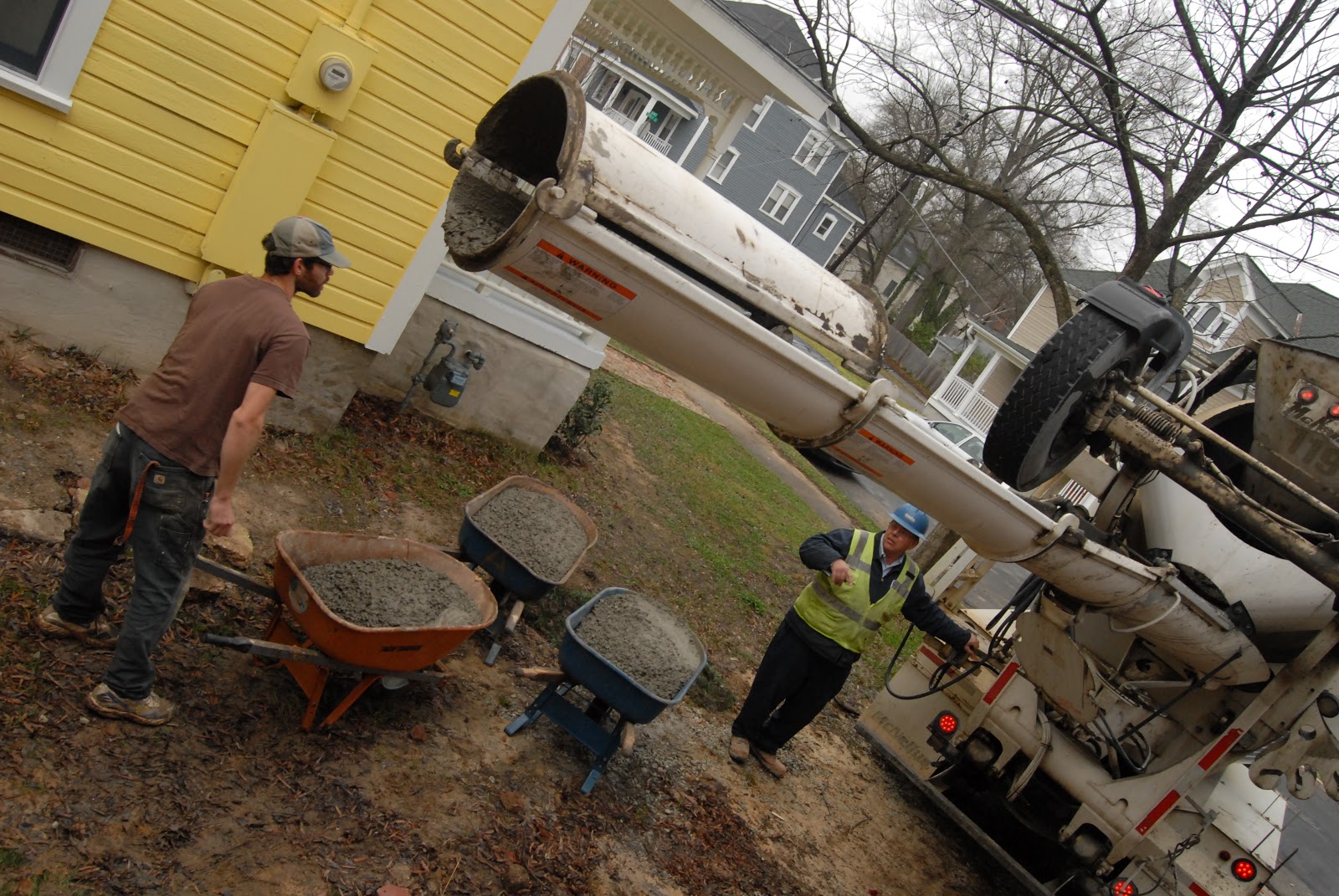
Here the forms are ready for the concrete truck (despite my previous post about how much I preferred hand-mixing concrete to having a truck come, this would have been 243 bags to mix, which I didn't feel physically up to):


Communicating with the driver about how far to inch forward to get the chute in the right place:


And pouring!


We had more than three wheelbarrows of extra concrete at the end (I ordered a bit more than I thought we needed, just in case something went wrong, or my math was off...)


I had thought the previous day about where extra concrete might be helpful, and had decided that a landing at the bottom of the side steps would be nice:


Here is what the finished retaining wall is looking like. You can see "honeycombing" below at the bottom of the wall (the area where the gravel is exposed, and it isn't smooth). This is where the concrete was initially too dry during the pour. I asked the driver to add some water to the mix and it worked a lot better.


You can see the "weep holes" in this wall. They are white PVC pipe - I will cut the ends off so that they are flush with the wall. I like the faceted corner detail, shown below:


The addition isn't in a very pretty state right now, which concrete forms everywhere, and plastic on the roof, and pink foam sheathing contrasting with black tar paper. I'm excited to continue with the beautiful wood siding, and greening the roof, and putting in windows.


I don't have many good photos of the process of putting up the EPDM roof liner, but you can see it hanging over the edge in the next two shots. Immediately below, you can notice the transition from the back porch roof to the EPDM roof. The porch had clear plastic roofing (which you can kind of see in the photo above), but we switched it to metal and extended it so that it overlapped over the EPDM.